

Talk To Your Family About Cancer Risk
What is the 'Talk To Your Family About Cancer Risk' resource?
This resource has been developed to support people with hereditary cancer risk to talk with their families about their risk, helping them navigate the important considerations and conversations that may arise.
What does ‘hereditary’ mean? Hereditary is a trait or condition passed down from parent to child. If something is hereditary, it runs in families, such as eye colour or risk for cancer. For hereditary cancer risk, children have a 50/50 risk of inheriting the gene.
Who is this resource for?
This resource is for people who have a hereditary cancer risk. It can help you talk about this information with close family members and, if relevant, other blood relatives, such as cousins, who may also be affected.
It could also be given to all family members to help them understand and plan next steps. Genetic counsellors might also find this useful to give to their patients.
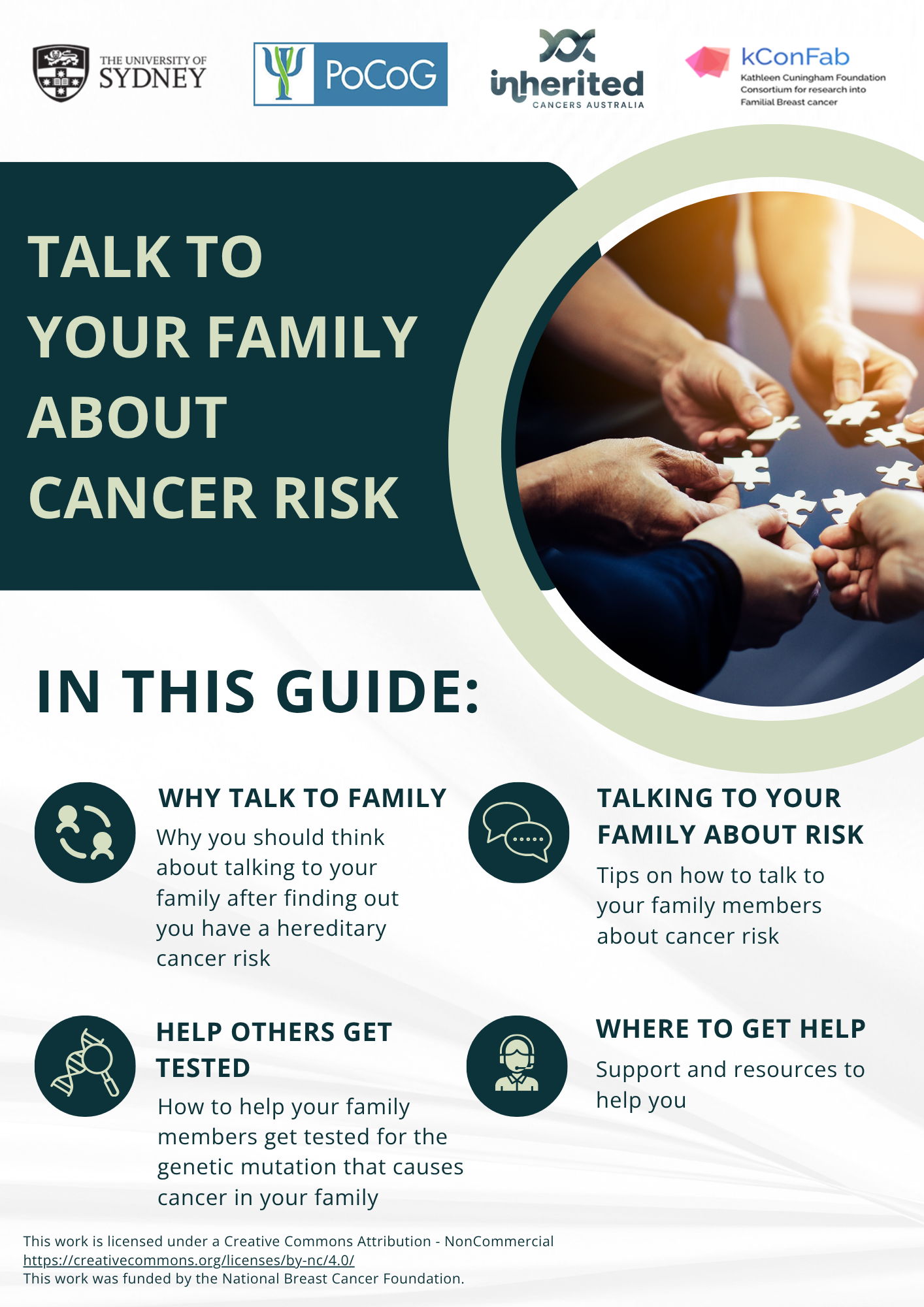
The resource has 4 sections: Why Talk To Family (Page 4), Help Others Get Tested (Page 5), Talking To Family About Risk (Page 8), Where To Get Help (Page 12).
Why was this resource made?
PoCoG made this resource in collaboration with The Kathleen Cuningham Foundation Consortium for Research Into Familial Breast Cancer (kConFab) and Inherited Cancers Australia (ICA).
Researchers at the University of Washington, USA, developed a public website called ConnectMyVariant to support family communication of hereditary cancer risk. We recognised that many Australian families find it challenging to share information about hereditary cancer risk with relatives who may also be affected. We did a recent study to explore the acceptability of ConnectMyVariant resources, identify content requiring adaptation, and any need for additional resources. This process made sure the resources were relevant and useful for Australians.
How was this resource made?
Semi-structured interviews were conducted across three stages to review the ConnectMyVariant resources, assess relevance and acceptability for Australians, and identify need for adaptation. Stages 1 and 2 involved individuals with an identified hereditary cancer variant and their relatives. Stage 3 involved genetic counsellors. Resource content was revised between stages based on interview findings. The full findings of this study are published in the Psycho-Oncology Journal here.